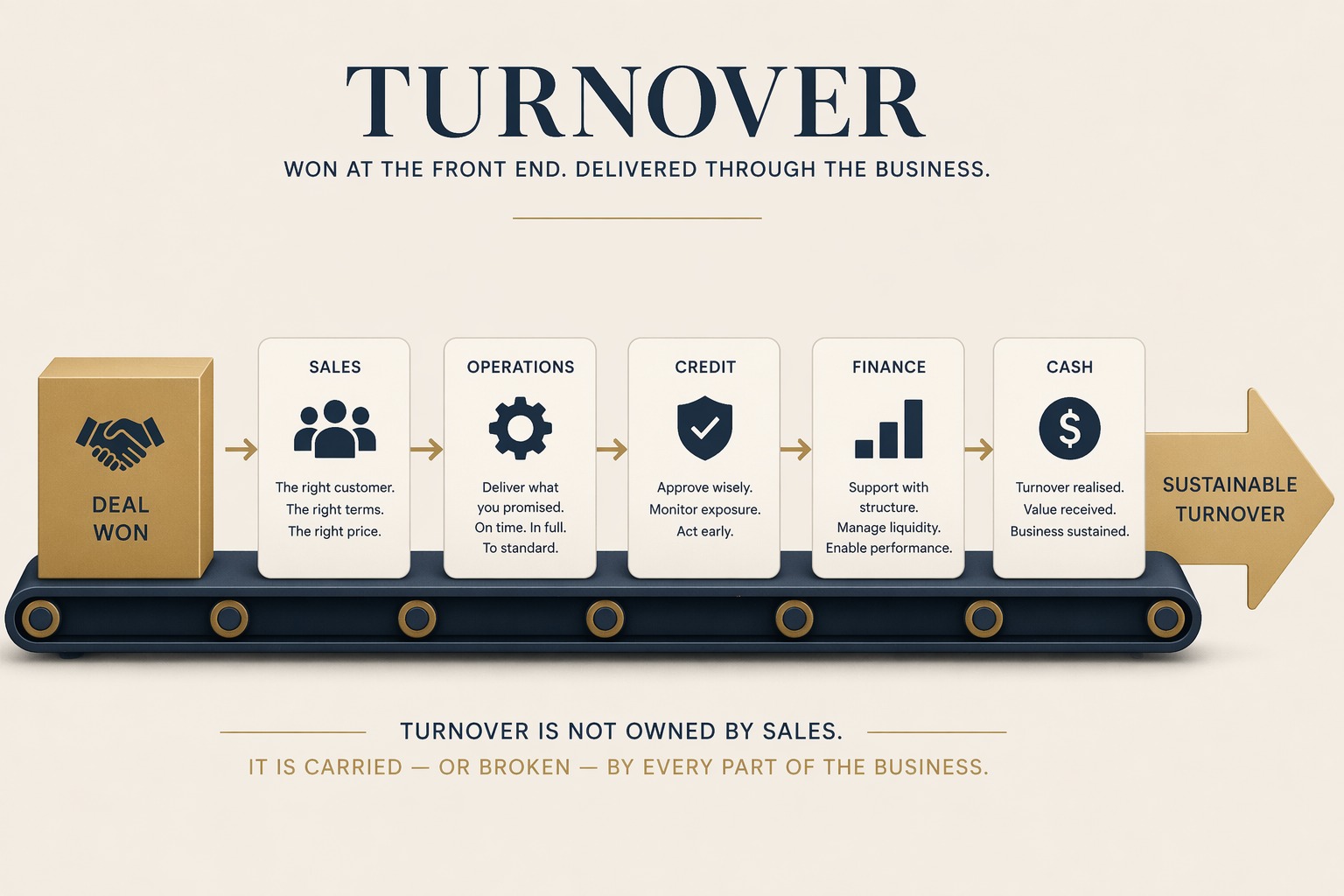
Why Turnover Fails After the Sale
Turnover doesn’t only fail at the point of sale. It fails afterwards.
We talk a lot about how businesses lose profit. And how they run out of cash.
But turnover is just as fragile, because closing the deal is only the beginning.
What happens next, inside the business, determines whether that turnover is real, or if it leaks through the system.
I’ve seen this happen in ways most people don’t connect.
A deal is signed without considering operations:
Production can’t meet the volume or timing. Orders are delayed, reduced, or cancelled.
Sales push urgency:
Teams work overtime. Fatigue increases. Mistakes happen. Quality drops.
Out-of-spec orders are accepted:
Safety and process are compromised to “make it work”.
Customers are given more credit or extended terms than they can afford:
Credit control steps in. Accounts are suspended. Relationships strain. Future sales are lost.
Cash is stretched to fulfil large or unique orders:
Finance tightens spending. The business can’t sustain the very growth it created.
And on paper, it still looks like “good turnover”.
Until it isn’t.
Turnover is not owned by sales. It is carried, or broken, by every part of the business.
If the system isn’t aligned, what you win at the front end can be lost, sometimes completely, on the way through.